

- Stock: In Stock
- Product code: 827588000004169285
- Weight Brutto: 23.00kg

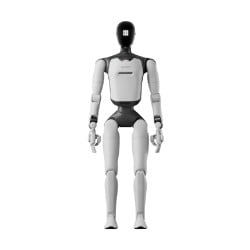
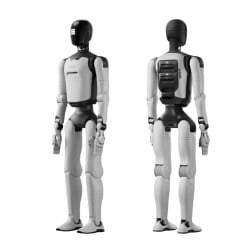
Programmable Panda Robot AgiBot D1 EDU Panda for STEM and Research
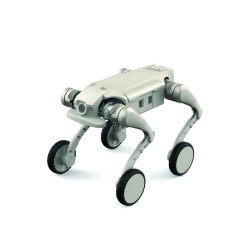
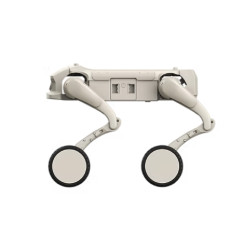
AgiBot D1 EDU Panda - is a quadruped robot with 12 degrees of freedom designed for learning robotics, researching motion control algorithms, and building custom software solutions. The structure combines aluminium alloy and high-strength engineering plastic. The drive system consists of 12 precision motors with up to 48 N·m torque. The robot is also equipped with an IMU inertial module and a wide-angle camera. Maximum movement speed is 3.5 m/s, and payload reaches 3.3 kg. The platform supports secondary development via an open SDK and provides physical interfaces for connecting additional hardware.
Advantages of the AgiBot D1 EDU Panda
- 12 degrees of freedom. Each leg of the robot has three movable joints. This kinematic configuration lets you change body posture, control limb placement, and program different locomotion options.
- Speed up to 3.5 m/s. The robot can move quickly, including across uneven and sloped surfaces. A reinforcement learning-based gait control system adapts to terrain changes and ground support conditions.
- Balancing and fall protection. Control algorithms provide self-balancing, tip-over resistance, and compensation for external pushes, enabling research into quadruped robotic platform stability.
- Motors with up to 48 N·m torque. The drive system consists of 12 precision actuators in aluminium housings. Peak torque of each joint is 48 N·m, providing sufficient force for dynamic movements and jumps.
- Overcoming obstacles and steps. AgiBot D1 EDU Panda can climb steps up to 16 cm high and ascend slopes up to 30°. Vertical jump height reaches up to 35 cm.
- Payload up to 3.3 kg. Compatible additional equipment can be mounted on the robot body, allowing experiments with external sensors and compute modules.
- Secondary development support. An open SDK and a set of Ethernet, USB, Power Port, SBUS, and UART interfaces enable motion programming, connecting peripherals, and expanding platform functionality.
- Handheld controller operation. The kit includes a joystick remote for remotely controlling robot movement and triggering built-in motion commands without connecting a computer.
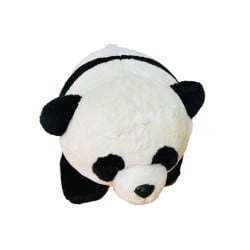
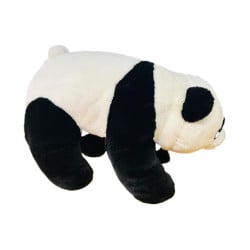
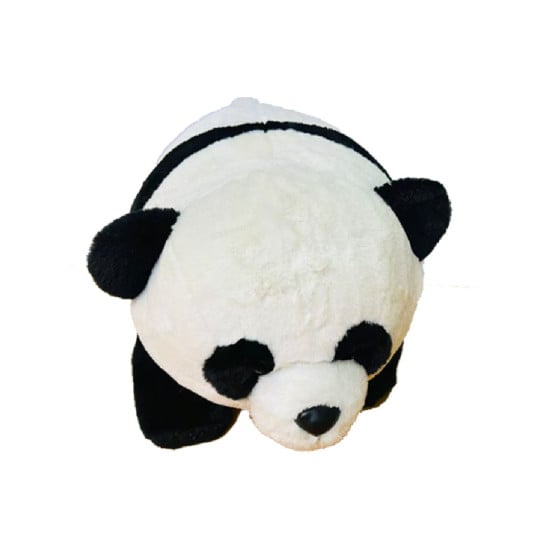
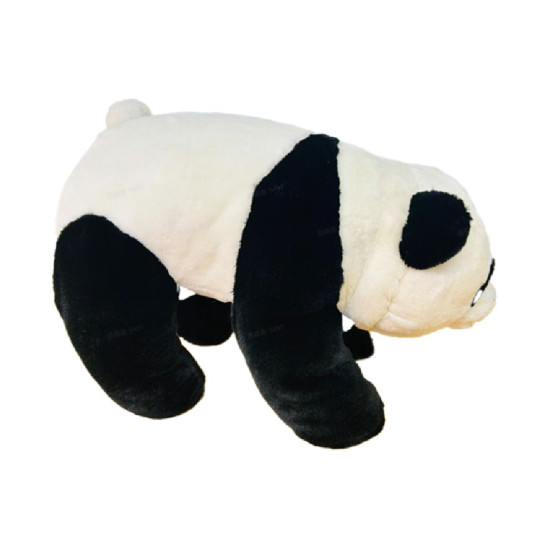
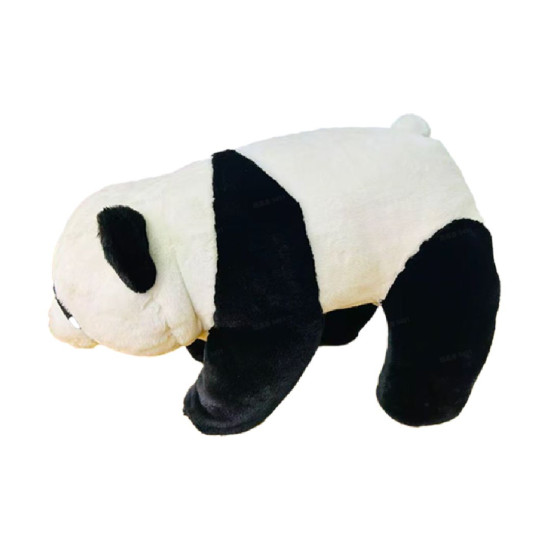
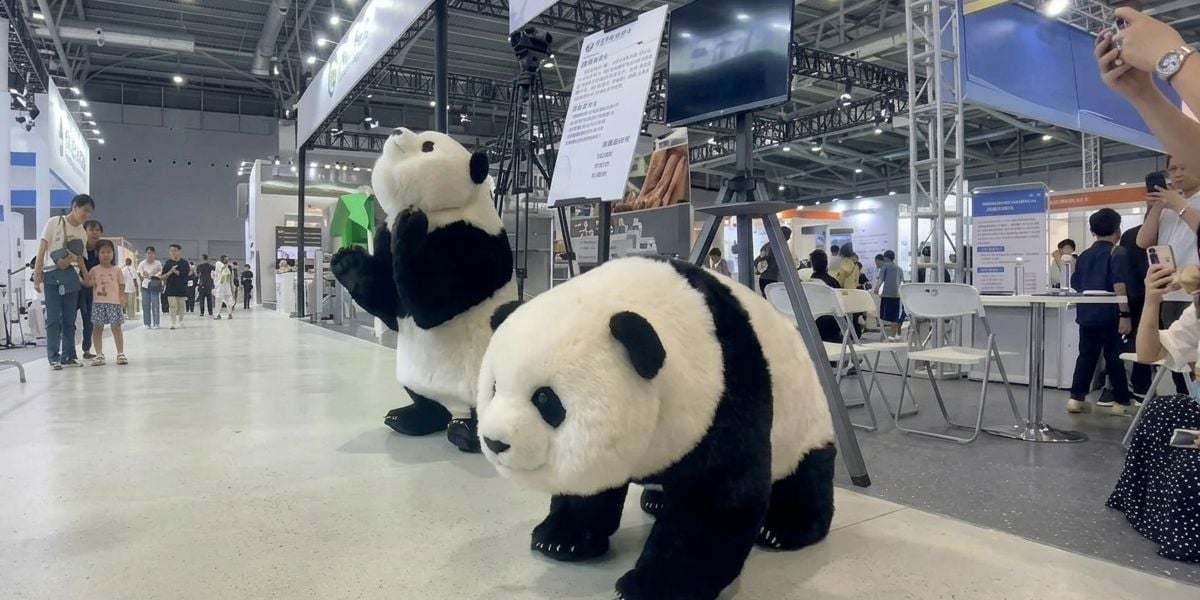
- Panda design. A removable plush panda suit gives the robot a recognisable appearance suited for STEM classrooms, exhibitions, presentations, and public demonstrations.
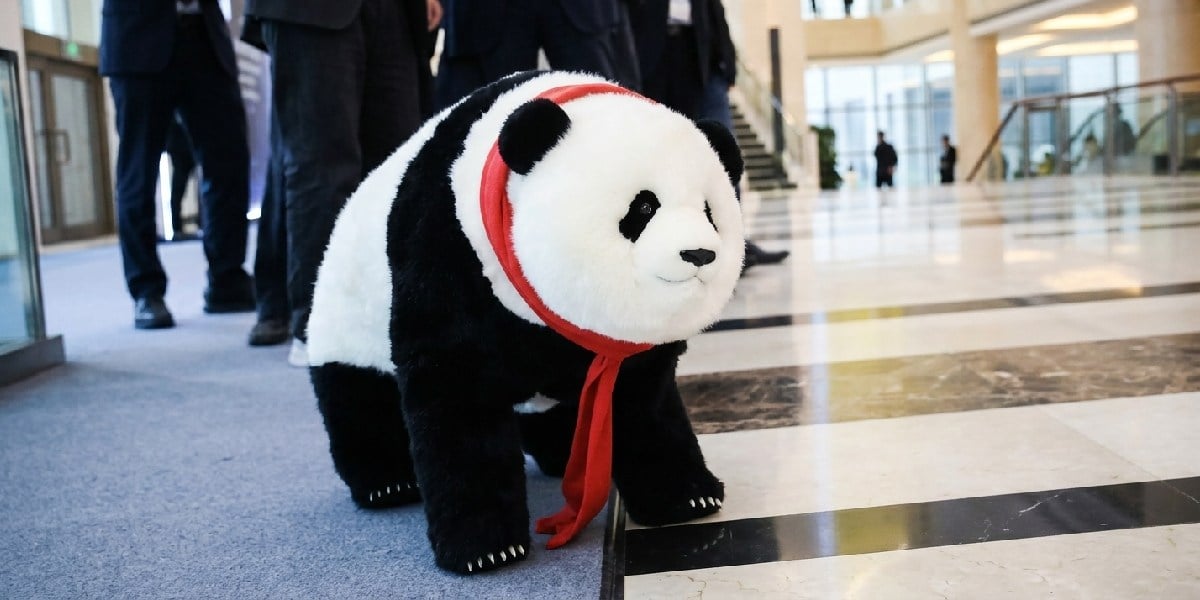
Robot Structure and Kinematic System
The AgiBot D1 EDU Panda body is made from aluminium alloy and high-strength engineering plastic. The mechanical structure includes four legs with three degrees of freedom each, giving the platform 12 precision joint motors in aluminium housings.
The drives use high power-density motor modules with dual encoders, eliminating the need for zero-position calibration before system startup. Peak torque of each joint reaches 48 N·m.
Joint range of motion:
- Body. From -28° to +28°.
- Hip joint. From -170° to +66°.
- Shin joint. From +35° to +156°.
Actuator configuration lets you change leg positions relative to the body, adjust platform height, and control body tilt. Independent joint control allows setting limb trajectories and researching quadruped robot kinematics.
Motion Capabilities and Locomotion
AgiBot D1 EDU Panda supports standard locomotion modes and a set of special acrobatic commands, controlled via the handheld controller or SDK software interfaces.
Key locomotion parameters:
- Maximum speed. Up to 3.5 m/s.
- Step height. Up to 16 cm during sequential climbing.
- Maximum incline angle. Up to 30°.
- Vertical jump height. Up to 35 cm.
- Travel range. 6 ± 1 km.
- Battery life. 1 to 2 hours depending on load and movement mode.
Body posture commands:
- Standing. Transition to an upright stance.
- Lying. Transition to a lying position.
- Damping Mode. Passive drive actuator state.
- Pitch Adjustment. Adjusting body tilt forward or backward.
- Height Adjustment. Adjusting body height.
- Horizontal Turning. Turning in the horizontal plane.
Additional motion commands include forward jump, upward jump, standing on two hind legs, backflip, and waving a paw. These functions can test balancing algorithms and limb coordination, with high- and low-level interfaces available for programming custom motion scenarios.
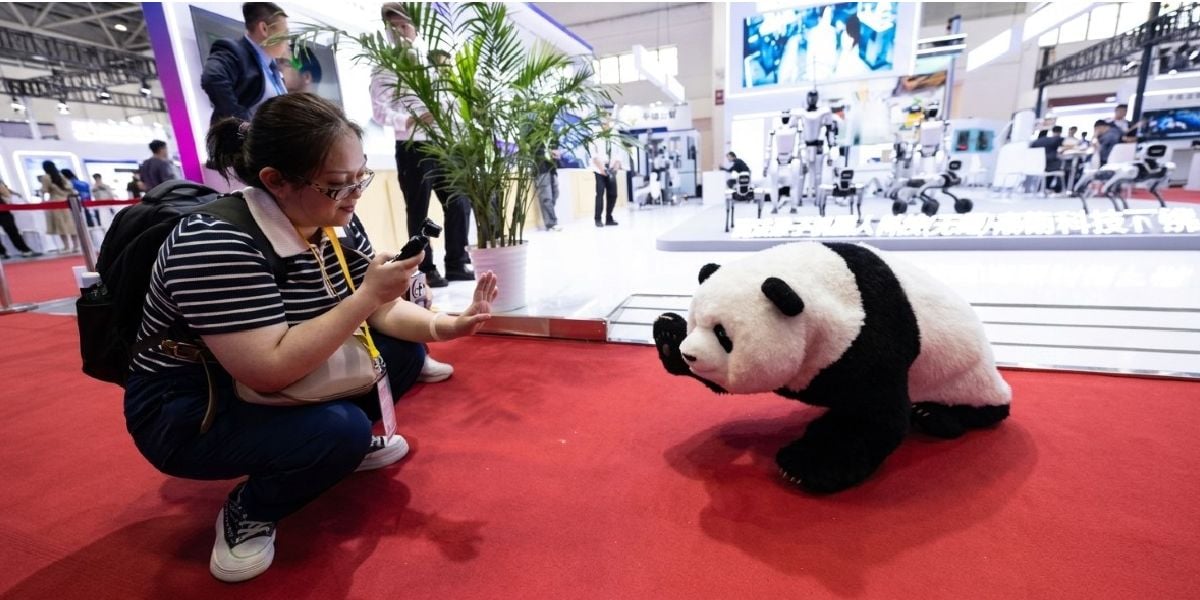
Sensors, Camera, and Control System
An IMU inertial measurement unit determines the robot's position in space by recording acceleration, angular velocity, and body orientation. These readings are available through the SDK for software experiments in balancing and gait stabilisation.
A wide-angle camera is mounted on the body with the following field-of-view specifications:
- DFOV. 122°.
- HFOV. 111°.
- VFOV. 70°.
The camera streams real-time video to an external device for visual monitoring during remote control. The computing system runs on an eight-core processor, and maximum platform output power is 3500 W.
Secondary Development and Programming
The AgiBot D1 EDU Panda educational platform supports software and hardware customisation through an open SDK, communication protocol, and physical interfaces for integrating external sensors and compute devices.
The SDK software package provides access to these functions:
- High-level control. Sending commands to move forward and backward, adjust speed, turn, lie down, and return to a four-legged stance.
- Low-level control. Sending direct commands to motors with specified position, speed, and torque for each joint.
- IMU data access. Reading real-time information on acceleration, angular velocity, and body orientation.
- Motor monitoring. Receiving telemetry on current joint position, rotational speed, and torque.
- Video stream access. Streaming video from the robot's camera to an external computer for computer vision processing.
- Control mode switching. Programmatically changing control priority between the handheld controller and the SDK.
Expansion Interfaces
For connecting additional equipment, AgiBot D1 EDU Panda includes these interfaces:
- Ethernet, 1 port. RJ45 network connector for data transfer, network connection, and remote monitoring.
- USB, 2 ports. For connecting external storage, cameras, sensors, and other compatible devices.
- Power Port, 2 ports. For powering external modules. Stated output ratings of 12 V up to 36 W and BAT up to 100 W require confirmation against official documentation.
- SBUS, 1 port. Interface for connecting remote control receivers and other SBUS-compatible hardware.
- UART, 1 port. Serial interface for data exchange with embedded systems and communication modules.
The platform supports integrating add-ons including LiDAR, depth cameras, positioning modules, RTK receivers, 4G/5G communications, and video transmission modules. A URDF digital model format allows simulation and preliminary algorithm testing in NVIDIA Isaac Sim and MuJoCo before deploying onto the physical platform.
Applications
AgiBot D1 EDU Panda is built for teaching laboratories, university robotics departments, research projects, as well as public presentations and technology events.
- Mobile robotics experiments. Researching locomotion algorithms, actuator control, and quadruped platform behaviour on uneven and sloped surfaces.
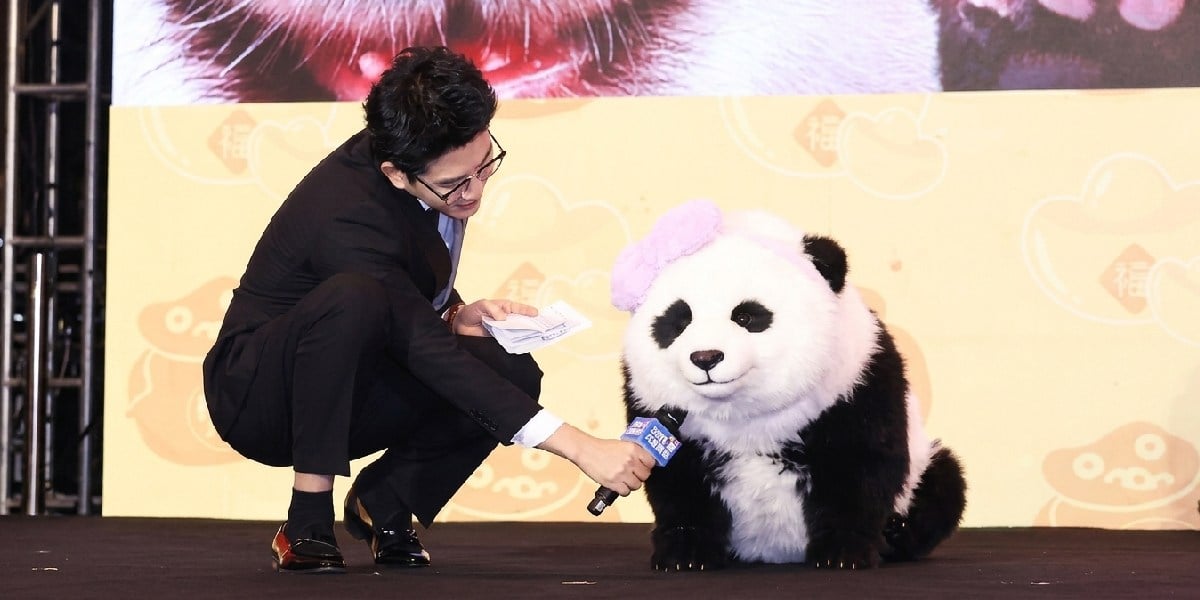
- Celebrations, grand openings, and promotions. The robot in a panda suit can take part in ribbon-cutting ceremonies, wedding events, holiday photo zones, and venue openings, accompanying guests, offering a paw, performing dance moves, and posing for photos.
- Robotics training and STEM education. Studying quadruped robot design, actuator principles, kinematics, and motion control algorithms in schools, clubs, STEM labs, and universities, with the panda look making interaction more approachable and engaging for children and teens.
- Rehabilitation, children's, and inclusive spaces. Hosting interactive demos and developmental sessions in children's centres, where the plush panda design makes first encounters with complex technology less formal.
- Social media and media content creation. Filming short videos, reviews, and interactive clips featuring the panda robot to promote brands, educational platforms, and tech channels.
- Student and research projects. Developing software, testing control algorithms, integrating hardware modules, and studying quadruped robotic system principles.
- Interactive events and demonstrations. Running hands-on workshops, exhibitions, and presentations at educational institutions, laboratories, and technology centres.
What's Included
- AgiBot D1 EDU robotic platform - 1 pc. Main programmable educational quadruped robot with SDK support and interfaces for additional hardware.
- Removable Panda costume skin - 1 pc. Plush panda shell made from faux fur, nylon lining, mesh fabric, and PU leather, fitted over the robot's body and limbs.
- Rechargeable battery - 1 pc. Proprietary battery with 4.6 Ah capacity and 43.2 V nominal voltage, providing 1-2 hours of autonomous operation.
- Power adapter - 1 pc. Mains power supply unit for connecting to the charging dock.
- Charging station - 1 pc. Dock module for charging the battery. Charging from 10% to 90% takes about 1 hour.
- Adapter power cable - 1 pc. Mains cable for connecting the adapter to power outlets.
- Handheld controller - 1 pc. Joystick remote for remotely controlling robot movement and running built-in motion commands.
- Assembly tool set - 1 set. L-shaped hex keys in 2 mm, 2.5 mm, and 3 mm sizes for housing maintenance.
- User manual - 1 pc. Technical documentation with instructions for startup and safe operation.
- Certificate of conformity - 1 pc. Document confirming equipment compliance with established quality requirements.
Technical Specifications of the AgiBot D1 EDU Panda
| Parameter | Value |
| Device type | Quadruped robot |
| Body material | Aluminium alloy, high-strength engineering plastic |
| Costume material | Faux fur, nylon lining, mesh fabric, PU leather, stuffing |
| Degrees of freedom | 12 |
| Maximum speed | 3.5 m/s |
| Operating time | 1–2 hours |
| Travel range | 6 ± 1 km |
| Payload | Up to 3.3 kg |
| Step height | 16 cm |
| Maximum incline angle | 30° |
| Vertical jump height | 35 cm |
| Maximum output power | 3500 W |
| Net dimensions | 950 × 480 × 550 mm upright; 950 × 480 × 330 mm lying down |
| Net weight | 15.5 kg |
Motors, Sensors, and Compute Module
| Parameter | Value |
| Actuator type | High power-density motor modules |
| Maximum joint torque | 48 N·m |
| Number of motors | 12 |
| Body motion range | From -28° to +28° |
| Hip joint motion range | From -170° to +66° |
| Shin joint motion range | From +35° to +156° |
| Camera DFOV | 122° |
| Camera HFOV | 111° |
| Camera VFOV | 70° |
| Inertial module | IMU |
| Compute module | High-performance 8-core CPU |
| Real-time video transmission | Supported |
Software Interfaces and Power
| Parameter | Value |
| SDK secondary development | Supported |
| Ethernet | 1 port |
| USB | 2 ports |
| Power Port | 2 ports |
| SBUS | 1 port |
| UART | 1 port |
| URDF modelling | Supported |
| NVIDIA Isaac Sim | Supported |
| MuJoCo | Supported |
| Battery type | Rechargeable battery |
| Nominal voltage | 43.2 V |
| Nominal capacity | 4.6 Ah |
| Charging time | About 1 hour from 10% to 90% |
| Operating temperature | From 0 to +40 °C |
| Warranty | 1 year |
Order the AgiBot D1 EDU Panda Robot
AgiBot D1 EDU Panda can be used in teaching laboratories, research centres, educational projects, and during technology presentations. The platform supports motion programming, integrating external devices, and developing custom robotics solutions. Our specialists will advise on working with the SDK and help select compatible sensors and expansion modules for your tasks.