Metal Powders for SLM Printing: C3D Engineering Standards
In powder metal 3D printing (SLM), the quality of the feedstock determines not only the finished surface but also the internal microstructure of the part. The C3D catalog features finely dispersed metal powders that have undergone vacuum or gas atomization. This ensures a stable particle size distribution and alloy purity, which is critical for eliminating detonation and ensuring print repeatability.
➤ Detailed properties of metallic powders (PL)
Technological Requirements for Materials in C3D
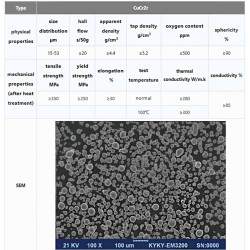
SLM technology places strict demands on particle morphology. Powders supplied by C3D have the following characteristics:
- Sphericity: The particle shape factor is as close as possible to unity. This ensures high flowability and dense layer deposition by the recoater.
- Particle size distribution (PSD): We offer particle sizes optimized for standard laser systems—primarily 15–45 µm and 20–63 µm. The absence of satellites (small particles adhering to the substrate) prevents agglomeration.
- Low impurity gas content: minimal oxygen and nitrogen content in C3D powders prevents embrittlement of the metal in the melt zone.
Suitable Application Areas
Metal 3D printing with C3D materials is effective in the following cases:
- Conformal cooling: creating complex channels inside injection molds to reduce the casting cycle by 30–50%.
- Weight reduction (Re-design): replacing massive components with hollow mesh structures without losing strength.
- Single-unit production: manufacturing spare parts for imported equipment that is no longer in use Production.
Alloy Range and Their Industrial Applications
In C3D, you can select a material for specific operational tasks:
Titanium Alloys (Ti6Al4V Grade 5 / Grade 23)
They have the highest strength-to-weight ratio. The material is biocompatible and corrosion-resistant.
Applications: Aerospace components, maxillofacial surgery endoprostheses, topology optimization elements.
Stainless Steel (316L, 17-4PH)
Austenitic 316L steel is characterized by high ductility and corrosion resistance. 17-4PH — maraging steel for parts requiring high hardness after heat treatment.
Applications: chemical engineering, jewelry, tool manufacturing.
Nickel superalloys (Inconel 718, Inconel 625)
Heat-resistant materials that retain mechanical properties at temperatures up to 700–900°C.
Applications: turbine blades, combustion chambers, heat exchangers.
Aluminum alloys (AlSi10Mg)
Silicon-magnesium aluminum provides a combination of lightness and good casting properties during laser melting.
Applications: electronics housings, cooling system components, brackets in Motorsports.
How to choose metal powder for a 3D printer?
When purchasing, it’s important to look not only at the alloy name. Pay attention to the particle size distribution (for SLM it is usually 15–45 microns or 20–63 microns).
The powder production method is also crucial. Gas atomization is considered the gold standard — it provides perfectly spherical particles, as mentioned earlier.
Important: working with metal powders requires caution. Fine particles suspended in the air can be flammable or harmful when inhaled. Always ensure proper protective equipment and adequate ventilation.
Ordering metal powder from C3D is cost-effective
By choosing powders from C3D, an engineer receives not just "material," but a predictable technological process:
- Product density up to 99.9% — the correct particle size distribution allows for a monolithic structure comparable to a forging.
- Savings through recycling — C3D powders are resistant to degradation. After screening, unused material retains its properties for the next printing cycle.
- Composition Certification - Each batch is accompanied by a quality certificate indicating the precise chemical composition and particle distribution.
- Absorption Coefficient Stability - Uniform particle color and texture ensure predictable energy transfer from the laser to the material.
Metal powders are an investment in quality. By choosing trusted manufacturers, you save yourself the headache of printing and ensure that your product will last for many years, whether it's a small mechanical component or a complex industrial assembly.