

- Stock: In Stock
- Product code: 827588000004140473
- Weight Brutto: 29.00kg
- SKU: AGI-D1 Ultra-W Patrol System

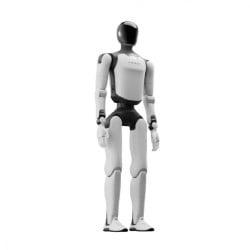
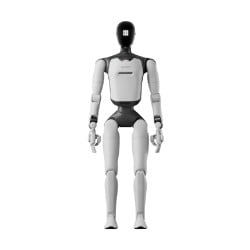
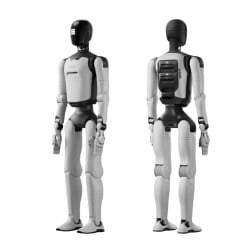
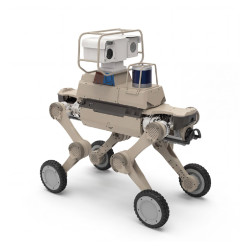
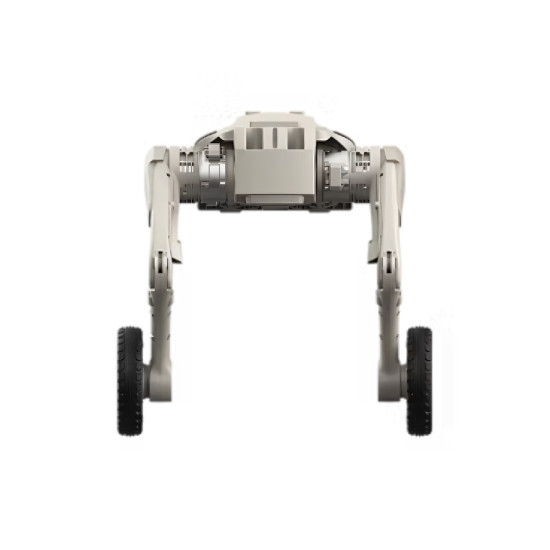
AgiBot D1 Ultra-W Wheeled-Legged Patrol Robot Dog
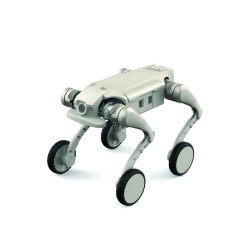
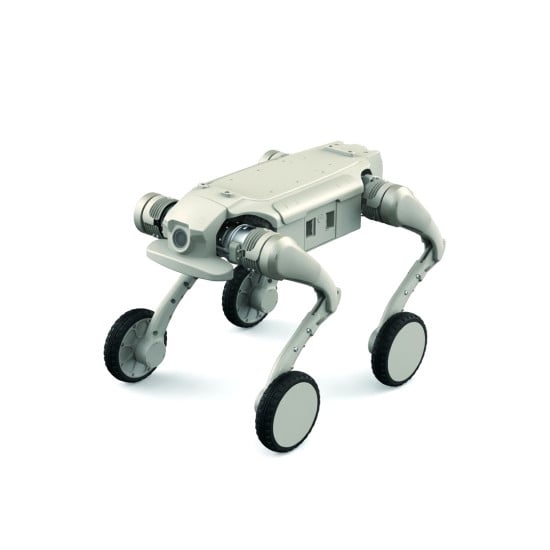
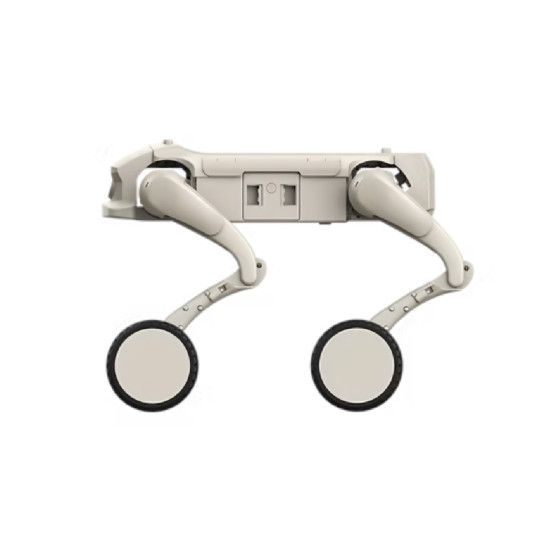
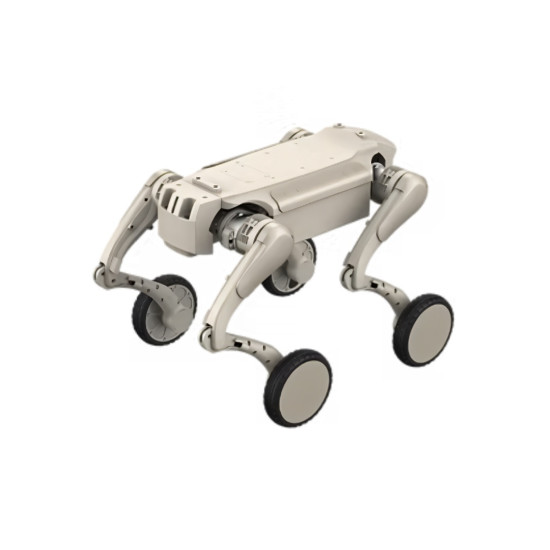
The AgiBot D1 Ultra-W patrol robot dog is a compact, industrial-grade quadruped robot with a wheeled-legged design, intended for site patrolling, equipment inspection, field research and the development of robotic systems. The platform is equipped with motorised joints, four hub-motor wheels, a front-facing FPV camera and a motion control system based on machine learning. The robot is rated for a payload of 5 kg, runs for 1–2 hours on a removable battery and has a range of 9 ± 1 km. The IP54-rated body and open SDK make it possible to adapt the device to the tasks of industrial enterprises, security services and research institutions.
Key Advantages of the AgiBot D1 Ultra-W
- Wheeled-legged design for moving across different surfaces. The four limbs are fitted with hub-motor wheels with solid six-inch tyres, allowing fast movement over flat sections at speeds of up to 3.7 m/s and the ability to negotiate changes in height.
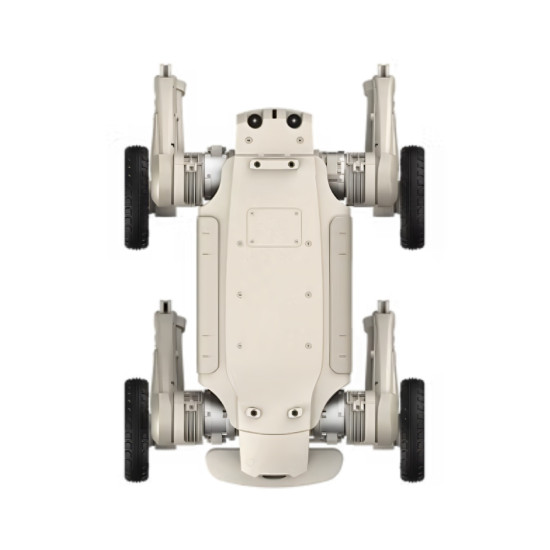
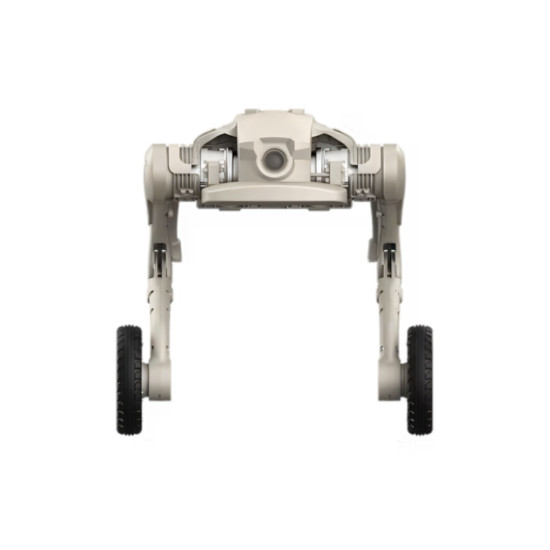
- Compact dimensions for working in confined spaces. The body width in the standing position is 430 mm, so the robot is suited to moving along narrow corridors and passages between production equipment.
- Automatic balance maintenance. A reinforcement learning algorithm adapts movements to the terrain, balances the body and prevents it from tipping over.
- Actuators with high power density. AgiBot's proprietary motorised joint system delivers a peak power density of 2 kW/kg and a maximum torque of 48 N·m.
- Moving on stairs and inclined surfaces. The platform consistently climbs steps 16 cm high, and the standard permissible climbing angle is 30°.
- Real-time video transmission. The front FPV camera with a resolution of 1920 × 1080 pixels streams the image to the operator for remote inspection of facilities.
- Option to install additional equipment. The 5 kg payload and standardised power and data interfaces make it possible to connect external cameras, sensors and navigation modules.
- Body protection against dust and splashes. The IP54 protection rating is suited to operating conditions in which the equipment is exposed to limited dust and water splashes.
- Support for developing custom applications. The open SDK, software interfaces, digital 3D models of the robot and compatibility with the Isaac Sim simulation environment are intended for creating and testing control algorithms.
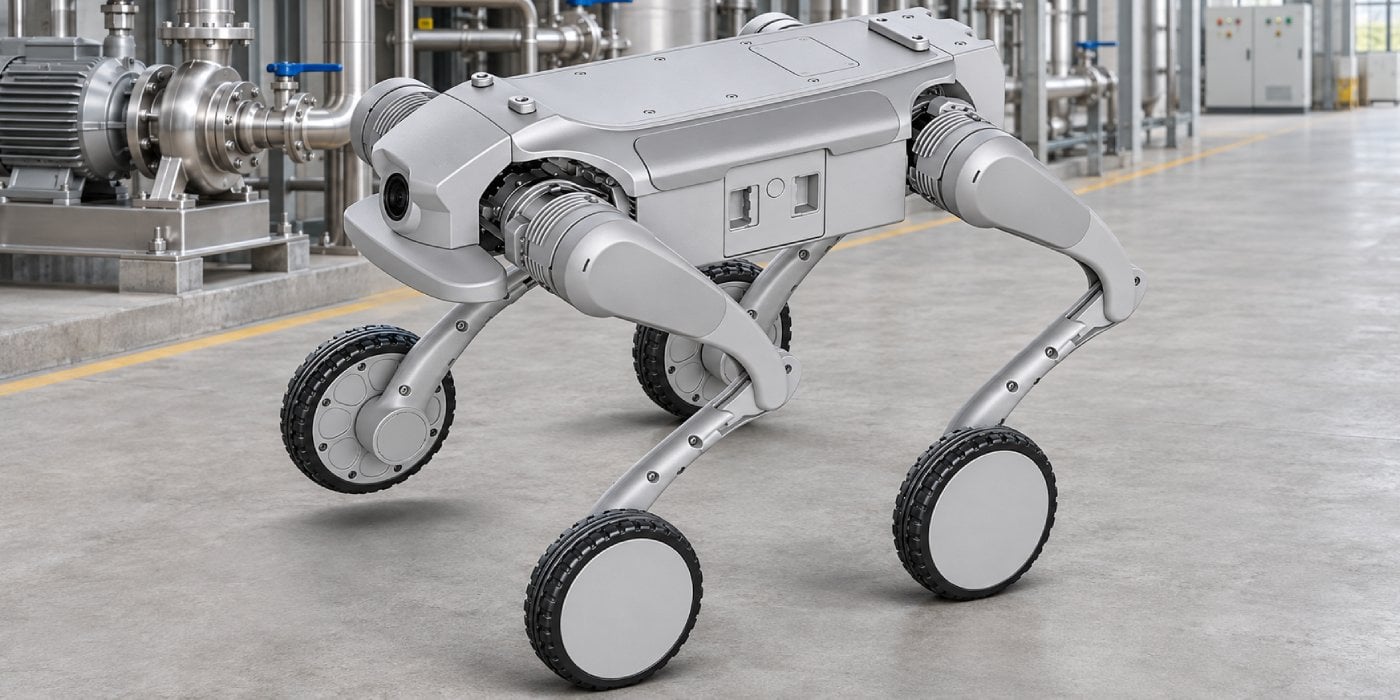
Wheeled-Legged Design and Motorised Joints
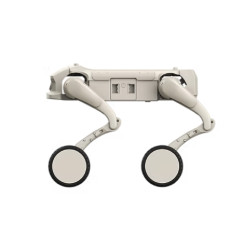
The AgiBot D1 Ultra-W has four limbs with 16 degrees of freedom in total, 4 per leg. Each limb consists of thigh and shank sections, motorised joints and a wheel with its own drive. The wheeled-legged design is a combination of walking limbs and hub-motor wheels, in which the wheel mechanism provides fast movement over a flat surface, while the movable limb joints adjust the body height, position and tilt angle.
The body is made of aluminium alloy and high-strength engineering plastic. The design includes front and rear anti-impact elements, protective bars and rubber pads. The total weight of the robot, including the battery, is 22 kg.
The limb kinematics support several body positions. The range of motion of the joints in the body area is from −28° to +28°, of the thigh joints from −170° to −66°, and of the shank joints from +35° to +156°. In the folded lying position, the height of the device is 165 mm, which simplifies transportation and storage.
Intelligent Motion Control Based on Reinforcement Learning
The AgiBot D1 Ultra-W control system is based on Reinforcement Learning. Reinforcement Learning is a machine learning method in which an algorithm builds motion control models for a quadruped platform on the basis of tens of millions of data points.
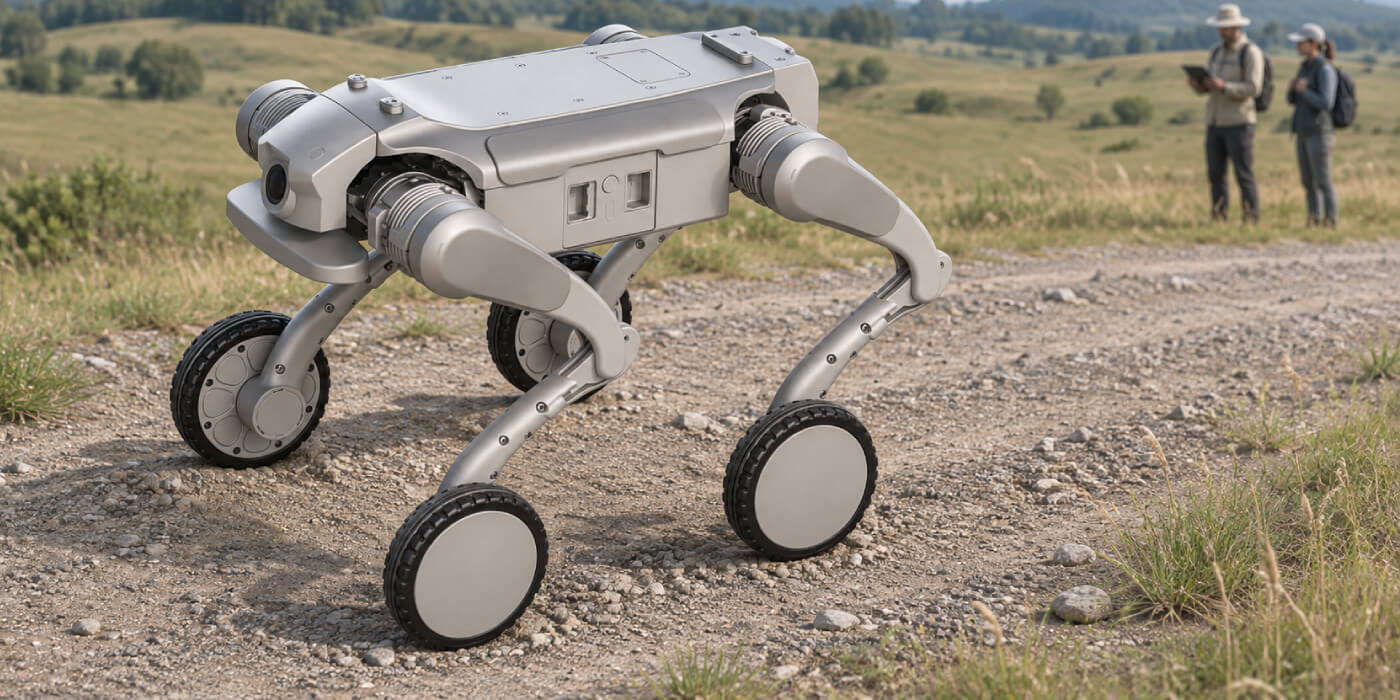
The algorithm adapts the work of the limbs to the characteristics of the surface when moving on stairs, gravel and uneven areas. The automatic balancing and anti-tipping functions help to maintain body stability during manoeuvres.
The standard sensor equipment includes an IMU inertial measurement unit. The IMU module is a sensor that provides data on the acceleration, orientation and spatial position of the robotic platform.
Normal and Turbo Operating Modes
The robot supports two control modes with different motion capabilities. Switching between them is done via the Dog Controller app on the remote control.
Normal Mode is the basic movement mode, intended for everyday tasks. The following actions are available in this mode:
- Movement in four directions. Forward, backward, left and right movement.
- Horizontal body rotation. Turning the platform on the spot.
- Pitch angle adjustment. Changing the tilt of the front and rear of the body.
- Lateral body tilt. Tilting the platform left and right.
- Stance height change. Switching between high and low body positions.
- Operating state change. Switching to the standing or lying position.
- Damping mode. Gradual, controlled lowering of the body.
- Motion state switching. Switching between holding a stationary position and moving.
Turbo Mode is a mode of increased motion performance, intended for research tasks and for demonstrating the dynamic capabilities of the platform. In addition to the standard actions, this mode offers vertical jumps up to 35 cm high, forward jumps, backflips, limb movements and standing on two legs. The duration of operation in Turbo Mode should be limited to avoid accelerated wear of the actuators. For emergency stopping, the robot can be quickly switched to the lying position.
FPV Camera and Remote Control
A FPV camera with a resolution of 1920 × 1080 pixels is installed at the front of the AgiBot D1 Ultra-W body. The FPV camera is a front-facing optical module for transmitting first-person-view video in real time, with a diagonal field of view of 122°, a horizontal one of 111° and a vertical one of 70°.
Control is carried out using a remote control with a built-in display, two joysticks, and navigation and function buttons. The Dog Controller app supports physical and virtual controls, body height changes and switching on the video stream.
The remote control supports screen recording and taking snapshots, with subsequent viewing of the files in the built-in gallery to document inspection or test results. A visual tracking function for a selected object is also available. For wireless communication, the robot is equipped with Wi-Fi modules in the 2.4 GHz band and Bluetooth 5.0.
Removable Battery and Charge Monitoring System
The AgiBot D1 Ultra-W is powered by a removable lithium battery with a nominal capacity of 4.6 A·h and a voltage of 43.2 V. A separate charging station and a mains adapter for a 100–240 V power supply are used for charging.
Charging the battery from 10% to 90% takes about 1 hour. Once full charge is reached, charging stops automatically. Four LED indicators on the battery housing are used to determine the charge level during operation and charging.
Separate light indication on the robot body informs the operator about the state of the equipment:
- Blue flashing. System start-up in progress.
- Blue. Boot-up complete and ready for operation.
- White. The increased motion performance mode, Turbo Mode, is active.
- Green. The visual object tracking function is active.
- Yellow. Battery charge level is below 20%.
- Yellow flashing. Battery charge level is below 5%.
- Red. Motorised joints are overheating.
- Red flashing. System malfunction.
When the charge level is below 20%, activation of the increased motion performance mode is blocked.
Programming and Connecting Additional Equipment
The AgiBot D1 Ultra-W supports software customisation according to the user's tasks. The open SDK contains developer packages, standardised software interfaces, digital 3D models of the robot and tools for integration with simulators. Compatibility with Isaac Sim makes it possible to test control algorithms in a virtual environment before running them on the physical platform.
The body has interfaces for connecting external devices:
- Ethernet RJ45. Data transmission at speeds of up to 1000 Mbit/s for network connection and remote monitoring.
- USB 2.0 and USB 3.0 Type-A. Connection of cameras, sensors, external storage devices and other USB devices.
- 12 V power connector. Power supply for compatible attached equipment with a current of up to 3 A.
- 43.2 V power connector. Power supply for external devices with a current of up to 3 A.
- SBUS. Connection of remote control receivers and devices that support the SBUS protocol.
- UART. Asynchronous serial data exchange with embedded systems and external communication modules.
Autonomous navigation functions and control of specialised attached equipment are implemented through additional programming and the selection of compatible hardware components.
Applications of the AgiBot D1 Ultra-W
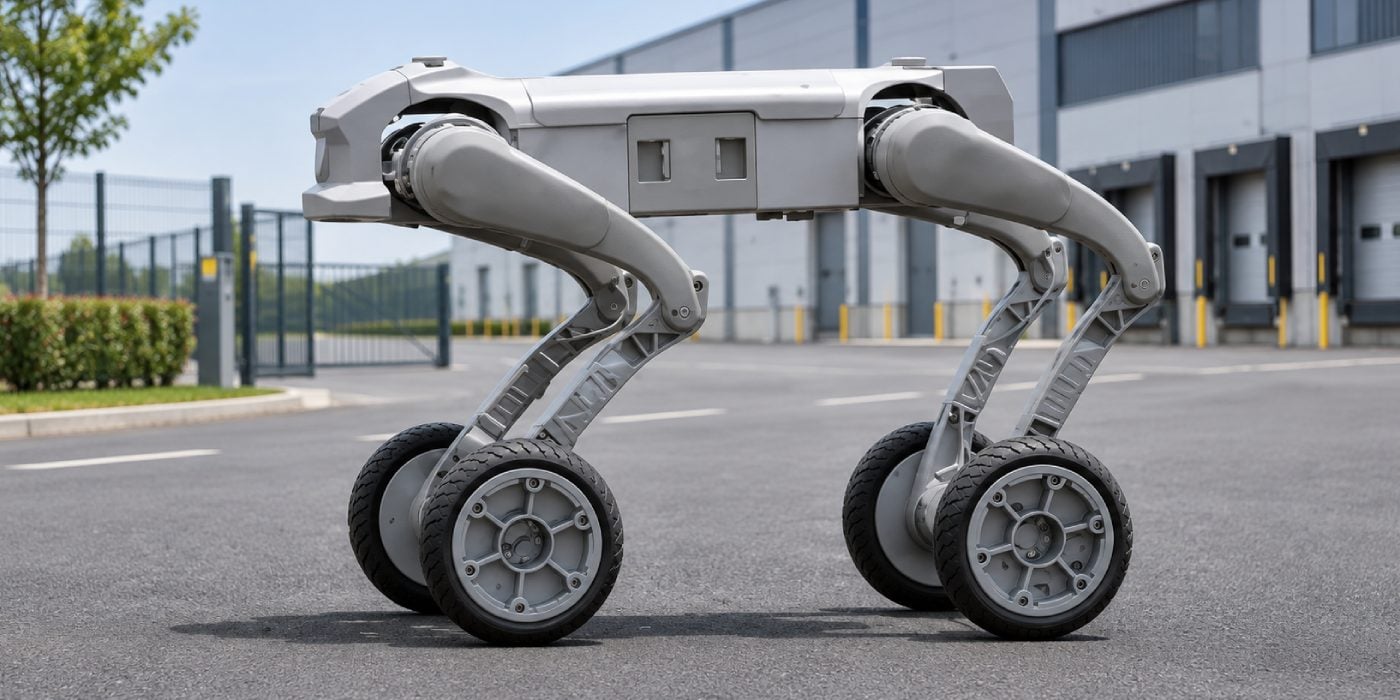
- Patrolling enterprise premises. Remote inspection of the perimeter, warehouses and rooms, with the video stream transmitted to the operator in real time.
- Inspection of industrial equipment. Visual monitoring of production lines, units and hard-to-reach technical areas using the front FPV camera.
- Field research. Movement over rough terrain, gravel areas and surfaces with changes in height within the operating parameters.
- Robotics research. Development and testing of algorithms for motion control, balancing and adaptation to complex terrain.
- Engineering education. Study of quadruped robot kinematics, reinforcement learning, sensor systems and programming of mobile platforms in technical educational institutions.
- Development of specialised robotic systems. Creation of mobile solutions with additional cameras, sensors and attachment modules for applied tasks.
- Demonstration of robotics capabilities. Showcasing the principles of wheeled-legged locomotion, body position control and special motion scenarios.
What's Included with the AgiBot D1 Ultra-W
- AgiBot D1 Ultra-W robot dog — 1 pc. A quadruped mobile platform with wheel drives.
- Removable battery — 1 pc. A lithium battery with a nominal capacity of 4.6 A·h and a voltage of 43.2 V.
- Remote control with display — 1 pc. A device for controlling movements, configuring functions and viewing the video stream.
- Charging station — 1 pc. A dock for charging the removed battery.
- Mains adapter — 1 pc. A power supply unit for connecting the charging station to a 100–240 V mains supply.
AgiBot D1 Ultra-W Technical Specifications
Design and Performance
| Parameter | Value |
|---|---|
| Model | D1 Ultra-W |
| Robot type | Quadruped robot with a wheeled-legged design |
| Body material | Aluminium alloy, high-strength engineering plastic |
| Number of degrees of freedom | 16 in total, 4 per limb |
| Number of wheels | 4 |
| Tyre diameter | 6 inches |
| Tyre type | Solid |
| Wheel drive type | Hub motor |
| Motion control system | Reinforcement Learning |
| Payload | 5 kg |
| Maximum speed | 3.7 m/s |
| Step height for continuous stair climbing | 16 cm |
| Standard climbing angle | 30° |
| Maximum climbing angle | 40° |
| Vertical jump height | 35 cm |
| Maximum obstacle clearance height | 60 cm |
| Maximum joint torque | 48 N·m |
| Peak power density of the joint system | 2 kW/kg |
| Range of motion of joints in the body area | From −28° to +28° |
| Range of motion of thigh joints | From −170° to −66° |
| Range of motion of shank joints | From +35° to +156° |
| Protection rating | IP54 |
| Operating temperature | From 0 to +40 °C |
| Net dimensions | Standing: 630 × 430 × 485 mm; lying: 690 × 540 × 165 mm |
| Net weight | 22 kg |
| Gross dimensions | 800 × 450 × 250 mm |
| Gross weight | 29 kg |
Battery Life and Power Supply
| Parameter | Value |
|---|---|
| Battery type | Lithium, removable |
| Nominal battery capacity | 4.6 A·h |
| Nominal battery voltage | 43.2 V |
| Battery life | 1–2 hours |
| Range | 9 ± 1 km |
| Charging time | About 1 hour from 10% to 90% |
| Mains adapter input voltage | 100–240 V |
| Automatic charge cut-off | Yes |
| Battery charge indication | 4 LEDs |
| Charging station | Included |
| External power connectors | 2 |
| 12 V power output | 12 V / 3 A |
| 43.2 V power output | 43.2 V / 3 A |
Sensors, Programming and Connectivity
| Parameter | Value |
|---|---|
| IMU inertial measurement unit | Yes |
| Camera type | FPV |
| Camera resolution | 1920 × 1080 pixels |
| Camera diagonal field of view DFOV | 122° |
| Camera horizontal field of view HFOV | 111° |
| Camera vertical field of view VFOV | 70° |
| Real-time video transmission | Yes |
| Visual object tracking function | Yes |
| Automatic balancing | Yes |
| Anti-tipping function | Yes |
| Operating modes | Normal Mode, Turbo Mode |
| Damping mode | Yes |
| Body height adjustment | Yes |
| Body tilt angle adjustment | Yes |
| Emergency stop | Yes |
| Remote control | With display |
| Control app | Dog Controller |
| Screen recording | Yes |
| Screenshot capture | Yes |
| SDK support | Yes |
| Digital robot models | Yes |
| Software simulation support | Isaac Sim |
| Wi-Fi | Wi-Fi 5 |
| Wi-Fi frequency band | 2.4 GHz |
| Wi-Fi transmitter power | 21 dBm |
| Bluetooth | 5.0 |
| Ethernet RJ45 | 1 × 1000 Mbit/s |
| USB 2.0 and USB 3.0 Type-A | 1 × USB 2.0 (5 V / 0.5 A), 1 × USB 3.0 (5 V / 1.5 A) |
| SBUS | 1 |
| UART | 1 |
The technical figures were obtained during laboratory tests, including in Turbo Mode. Actual performance depends on the type of surface, payload, control mode and operating conditions.
Operating Tips for the AgiBot D1 Ultra-W
- Checking components before start-up. Before each power-on, inspect the motorised joints, cables and support elements for foreign objects and damage.
- Keeping a safe distance. Ensure at least 1 m of free space around the robot before start-up.
- Caution on difficult terrain. When moving on inclined or uneven surfaces, avoid sharp turns and excessive speed, and do not operate the robot on slippery areas or near sharp obstacles.
- Monitoring actuator temperature. During prolonged operation, take breaks to let the actuators cool down, and if you notice unusual noise or impaired joint operation, stop and switch off the device immediately.
- Battery charging rules. Use only the standard battery, charging station and mains adapter, and do not leave the battery connected to the charger for more than 24 hours.
- Long-term storage conditions. Store the robot in a dry room protected from direct sunlight and strong electromagnetic fields, at a temperature of +20 to +25 °C and a relative humidity of up to 60%, carrying out a battery charge and discharge cycle every three months.
Buy the AgiBot D1 Ultra-W
Order AgiBot D1 Ultra-W from Center3DPrint for remote site inspection, industrial inspection and the development of mobile robotic systems. Our specialists will advise you on the technical specifications of the platform, the compatibility of attached equipment and the selection of a configuration for your tasks.